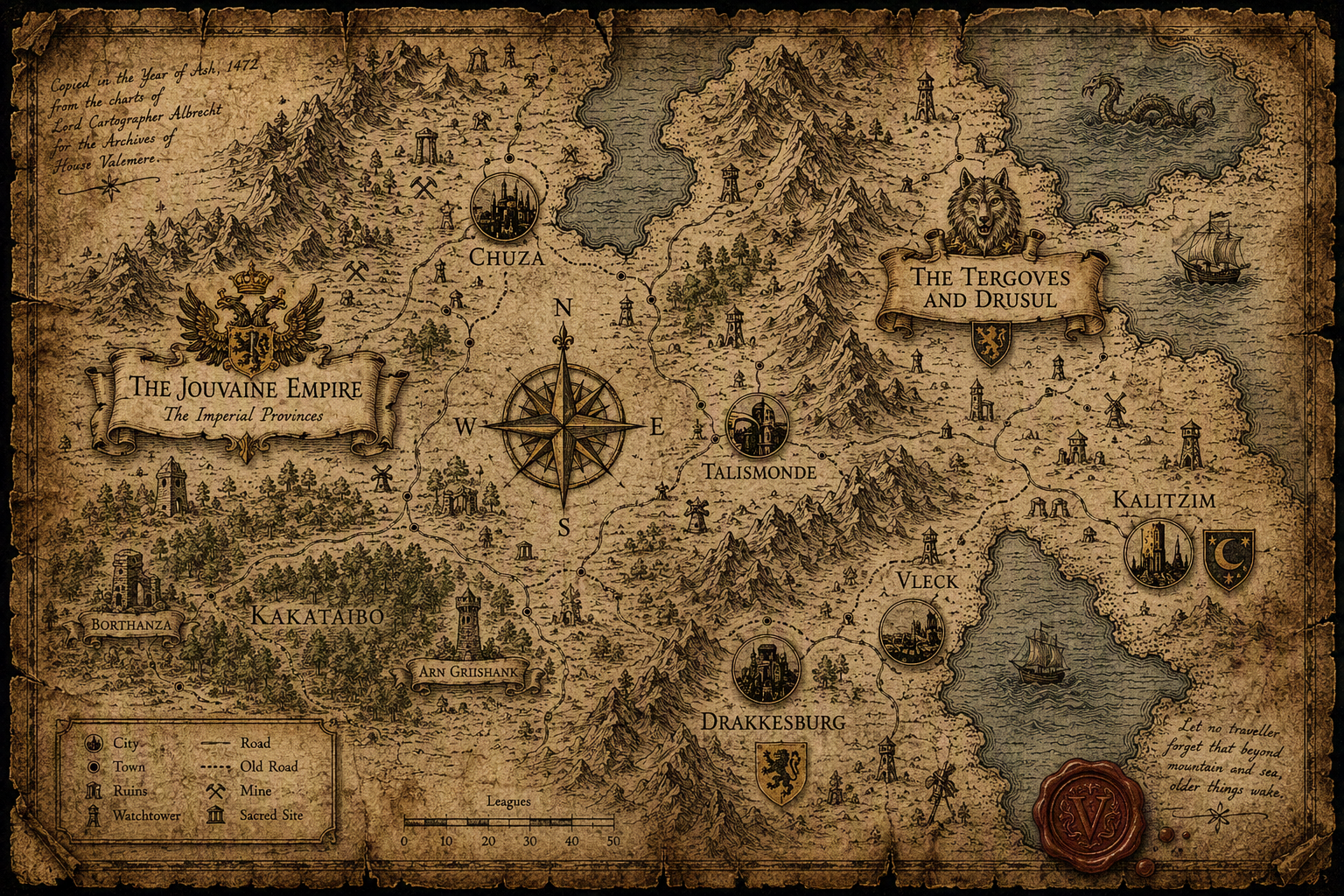
Section 18’s own case files rarely reach back further than a captain’s memory, but this one predates the Section itself by twelve centuries. What the Agents have pieced together – from Asquith, from what survives of the old war’s records, and from what’s crawled up out of the ground since – is that Chuza’s entire modern order was built directly on top of a catastrophe nobody alive actually witnessed, and that the catastrophe was never really finished.
The story starts with the War of Division: two sides, brother against brother, fought for the better part of two centuries over reasons the surviving records can’t agree on – religion, sorcery versus wizardry, land, or all three at once. It ended, abruptly and completely, with the Cataclysm. Legend – and Asquith’s own account backs it, however reluctantly – holds that a celestial body was plucked from the sky and hurled down deliberately, a demonstration of exactly what continued fighting would cost both sides. It worked. The impact tore a hole in the land forty miles across, swallowing towns and cities whole and destroying Chuza’s entire eastern edge outright – the “Rebuild” the history books still mention, dryly, as if it were an architectural choice rather than a crater. What we call the Bay of Chuza today is that same hole, filled in by the sea over the centuries since. The devastation was total enough, and mutual enough, that it forced the Summit – the fighting simply stopped, and the land was carved into the Empire and the New Imperial Lands that still eye each other across a cold peace today.
THE REALM
The Summit split the surviving land roughly down the middle – the Empire to the west, the New Imperial Lands to the east – and the millennium anniversary of that peace is now less than a year off, with every major city on the Empire side, Chuza included, already gearing up to mark it. Talismonde is the Empire’s capital on paper, seat of King Jothar DeLinden, who claims direct descent from the DeLinden line that has held the throne since the Summit. In practice, Chuza – under the ward of Lord Morden – is where the Empire’s actual business gets done, and has been for most of the Agents’ lifetimes.
What holds the New Imperial Lands together on the other side of that border is a genuinely open question at Section 18 – republic, magocracy, or something with no equivalent on this side, depending who’s asked. What isn’t in question is Voivod Krell, who has led it since long before anyone currently serving was born; whether that’s one man kept alive by sorcery across the centuries or simply a title worn by a succession of them is exactly the kind of thing Krell has never felt obliged to clarify. What filters back through informal channels is grimmer and harder to confirm: that NIL children are screened for sorcerous talent at twelve, and that the ones who pass are never seen by their families again.
South of the Empire proper, civilisation gives out entirely into the Green Hell – dense, humid jungle with the frontier town of Last Hope marking its practical edge, and the native Ndege and Fekratt tribe holding an uneasy truce with the logging camps further in.
FILE NOTES
Asquith’s own account, given reluctantly, fills in what the official histories leave out. Students of the Art, deep in the war, went looking for knowledge from beyond the world – gates, doorways to other realities, opened in the hope of finding an edge. They knocked on too many doors. Something answered, and what came through was never interested in being a weapon for either side. The scholars who summoned it ended up enslaved themselves – the first confirmed contact with the illithids, and the same enslavers who threw the celestial body that opened the Bay of Chuza, by Asquith’s own account – a warning shot, not a battlefield accident, and one that Overlord VoiVod Krell is said to have welcomed rather than resisted. The King of that era bound Asquith’s Order to carry the knowledge forward in secret and hunt down what the illithids left behind – a mandate the last three surviving Tol Kerrate Knights are, by all accounts, still operating under.
The fighting itself didn’t stop at the Cataclysm – it staggered on for a while after, out of habit more than purpose, until the Battle of Dunrath Fields effectively finished what the crater had started. By the time it was fought, the Empire and the NIL had technically already resolved their differences; the armies fought anyway, from a momentum some of them could no longer explain. Asquith himself took the field that day, not long after his own two children were executed on the King’s order – not for any crime, but to deny NIL spies any leverage they might have held over him. He won the engagement decisively all the same, and swore an oath of service afterward that has outlasted everyone who took it alongside him.
That Order – the Tol Kerrate – was originally twelve oath-bound Brothers, martial mages who fought through the War of Division before turning to more divine vocations once the Cataclysm made plain what the Art alone had cost. Twelve centuries on, it’s down to three names on record: Asquith, DikDik, and a third, Andros, who went venturing into Kalitzim and never returned – presumed lost, though nobody at Section 18 has ever seen a body to confirm it. Whatever the Cataclysm cost Chuza at large, it appears to have cost the Order sworn to guard its secrets rather more.
What the illithids left behind was the Children of the Eye – hybrid labourers bred during the occupation, abandoned rather than dismantled once their masters withdrew, and still resurfacing on a cycle nobody has explained thirty-three years after Asquith’s own Order tried to end it for good. Using stolen children as bait, they lured a horde of the Children into a cavern beneath old Paraisopolis and brought the roof down on all of it – the origin, plainly and without much dispute from Asquith himself, of the district Chuza still calls the Abandonment.
Running alongside all of this, and considerably less understood, is the Traugarim: New Imperial Lands necromancers who have spent decades quietly harvesting the dead from Empire battlefields rather than let anyone else claim the bodies – officially for study, but tied by more than one source to a specific millennium prophecy, one the Empire’s own calendar happens to be approaching within the year. What the prophecy actually promises depends entirely on who’s asked. What both sides agree on is that it involves the dead not staying that way.
Street level, the same history wears a cruder face: the Karnath cult, sandwich-board protestors chanting “Karnath protect us, Karnath deliver us” at every gate and riot line in the city, insisting the end of humanity is already underway. The name traces back to the Cataclysm itself – survivors of that first, deliberate demonstration spreading word of what they’d seen the sky do, a doom-telling that calcified over twelve centuries into a street prophecy nobody living remembers the original shape of. Whether “Karnath” ever named a god, a person, or simply the event itself has been lost somewhere in that telling – but the fear underneath it traces to something Section 18 now knows was entirely real.
STATUS: Filed under Locations as a lore/reference record, not an individual site. The Cataclysm is a thousand years closed as an official case – the Bay of Chuza, the Children of the Eye, the Traugarim, and the Karnath cult all suggest it never actually finished.