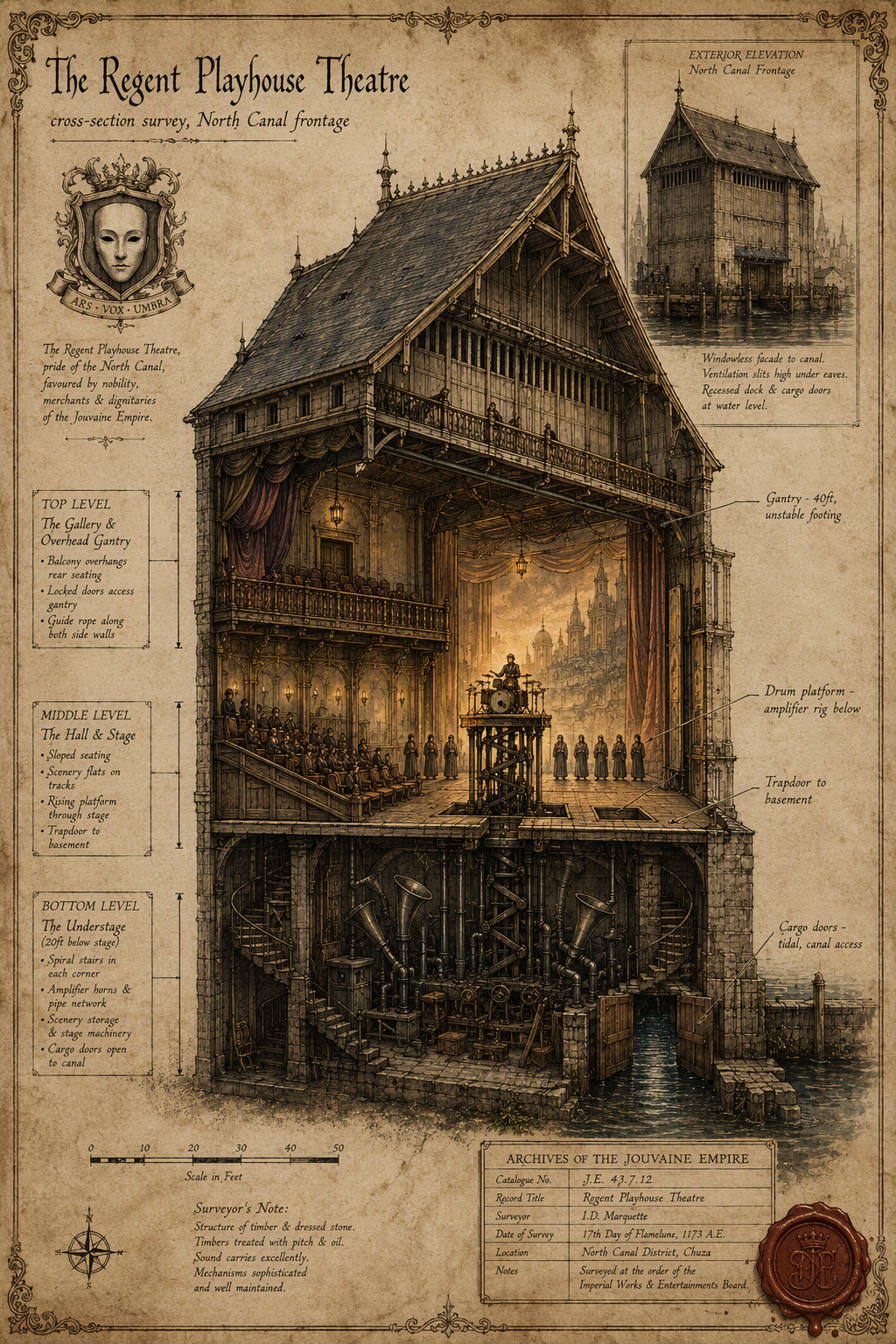
The Regent Playhouse Theatre stands where the North Canal empties into the Bay – a tall wood-and-stone building under an overhanging gothic roof, windowless on every side but for barred vents high under the eaves, its rear wall built directly over the recessed dock the canal runs into. On the night the Agents came looking for it, it was advertising a limited run of An Absence of Light, “starring Teecruise,” 8gp a ticket, with a foyer full of unsettlingly lifelike mannequins in black hooded robes and a bar pouring the jongleurs’ own house cocktail. Stairs down from the foyer lead to the restrooms – flickering coraman lights, a mirror rigged with a jump-scare prop, all treated as part of the show rather than a warning sign it very much should have been.
The hall itself seats its audience in sloped rows of wooden pews, the first two or three rows filled on a normal night, with a balcony and gallery overhanging the back of the room for latecomers and the irregular guest. Heavy curtains line the walls to keep the space dark and close. A locked door on either side of the gallery opens onto an overhead gantry running the full length of the room, forty feet up – a twelve-inch catwalk with a single guide rope, meant for curtain and rigging work rather than anyone in a hurry.
FILE NOTES
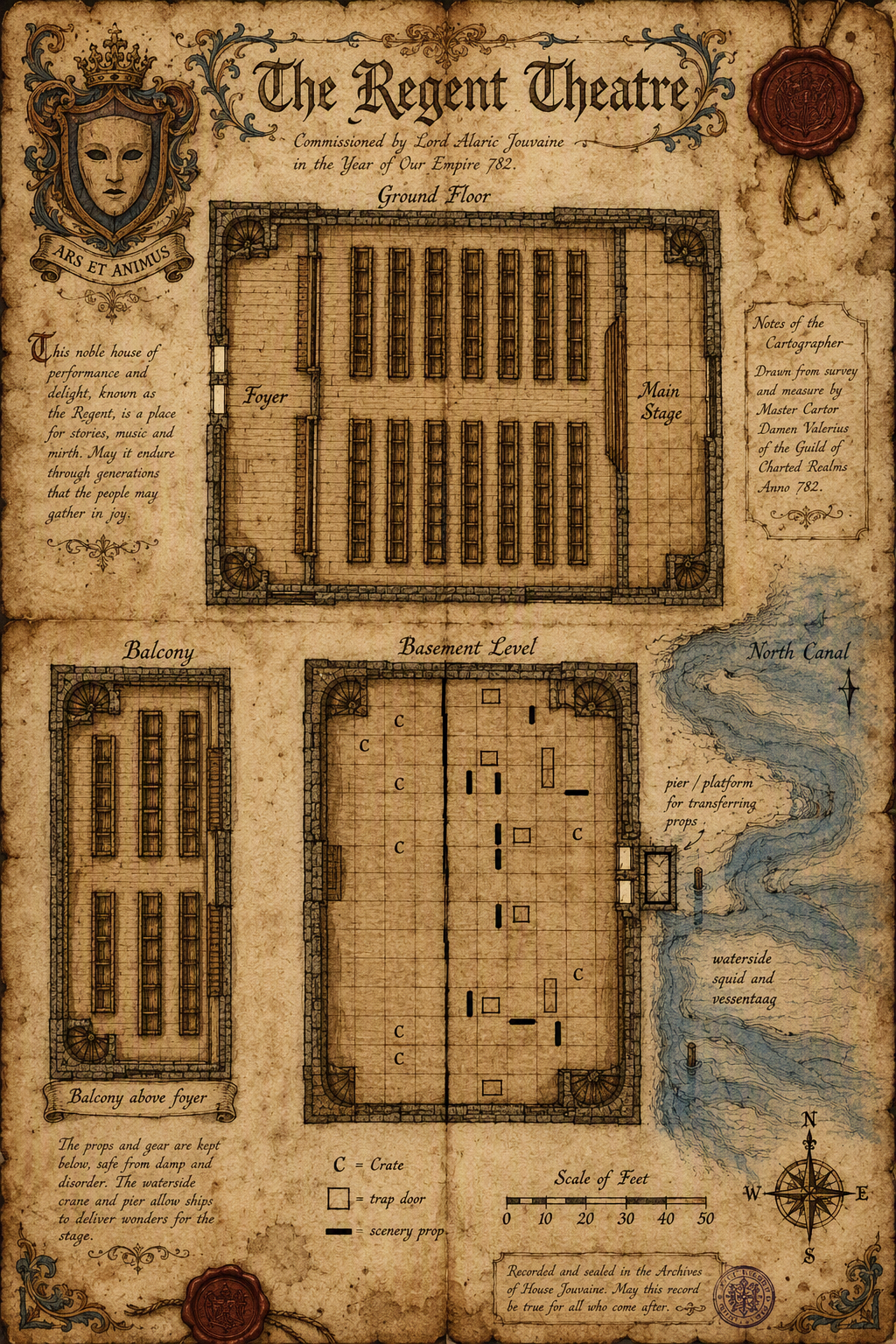
The stage is built for exactly the kind of trick that nearly worked: scenery flats that rise and drop on cue, portals the cast can vanish through mid-scene, and a trapdoor floor that opens straight down to the basement. Nine identically dressed performers, a drum charm strong enough to enthrall an entire packed house, and a curtain reveal that turned into a dozen identical Dr Griffiths mid-show were all part of the same act – right up until the letter bombs planted under every seat, primed to detonate on cue with the audience’s own scripted praise, stopped being part of the performance.
Underneath is where the real machinery lives. The basement sits twenty feet below the raised stage, reached by a tight spiral stair at each corner, and at its centre a rising platform lifts the drummer, Booznayha, up into view of the hall – fed from below by a bank of pipes and cone-shaped amplifiers that carry his drumming up through the floor and out into the gallery. It’s that rig, as much as the drummer himself, that turns one satyr’s playing into a spell that holds a full house still. Further back, heavy double cargo doors open directly onto the canal, permanently damp and streaked with weed – the same doors the Vessentaag used to deliver Henri by squid mid-raid, and the same ones something vast and tentacled came through to drag Griffiths and Pitr out into the water as the building came down around them.
None of it survived intact. The scenery flats that gave the basement its cover from perpendicular attacks are flammable, and once burning hands and a dropped torch got into them the fire spread through the whole understage faster than anyone could contain it. What didn’t burn collapsed into the canal along with most of the stage above it.
STATUS: Filed under Locations. Effectively destroyed – see Booznayha, TeeCruise, and Sanchez for who was inside when it went.