
The creatures guarding the breach at Borthanza aren’t simply beasts, whatever they’ve become.
Hairless, elongated skulls sit low over hunched, ridged shoulders, mottled blue-black hide shot through with dark red veining down the spine and along bony fin-like ridges at the back, a needle-toothed mouth locked in a permanent grimace.
Their eyes never stopped glowing a faint, sickly amber, even after the Scarab of Sustenance took the sight out of them – a detail that unsettles every Agent who’s had one lean in close before realising it can’t actually see them.
What they hunt with instead is sound: a constant click-click-click of echolocation that fills the corridors ahead of them long before they arrive, taloned hands and feet clacking against stone.
What the Agents eventually pieced together, from ruined murals and a survivor’s worth of guesswork, is worse than a simple monster infestation: the Grimlocks were githyanki once, and every one of them is still, technically, a captive.
A thousand years ago an illithid vessel crashed into the mountain and went to ground, its crew retreating into stasis, shielded from the rock’s own radiation. Their githyanki thralls bred on, generation after generation, in the dark outside – and lost their psionics doing it, inbred and isolated until nothing was left of what they’d once been.
The elders kept the doctrine alive as long as they could, guarding the knowledge of how to open the ship’s door back up.
Eventually even that was lost.
When the illithids’ nutrient stores ran dry early, the survivors developed a taste for flesh – starting, by what evidence there is, with a party of archaeologists who came too close.
FILE NOTES
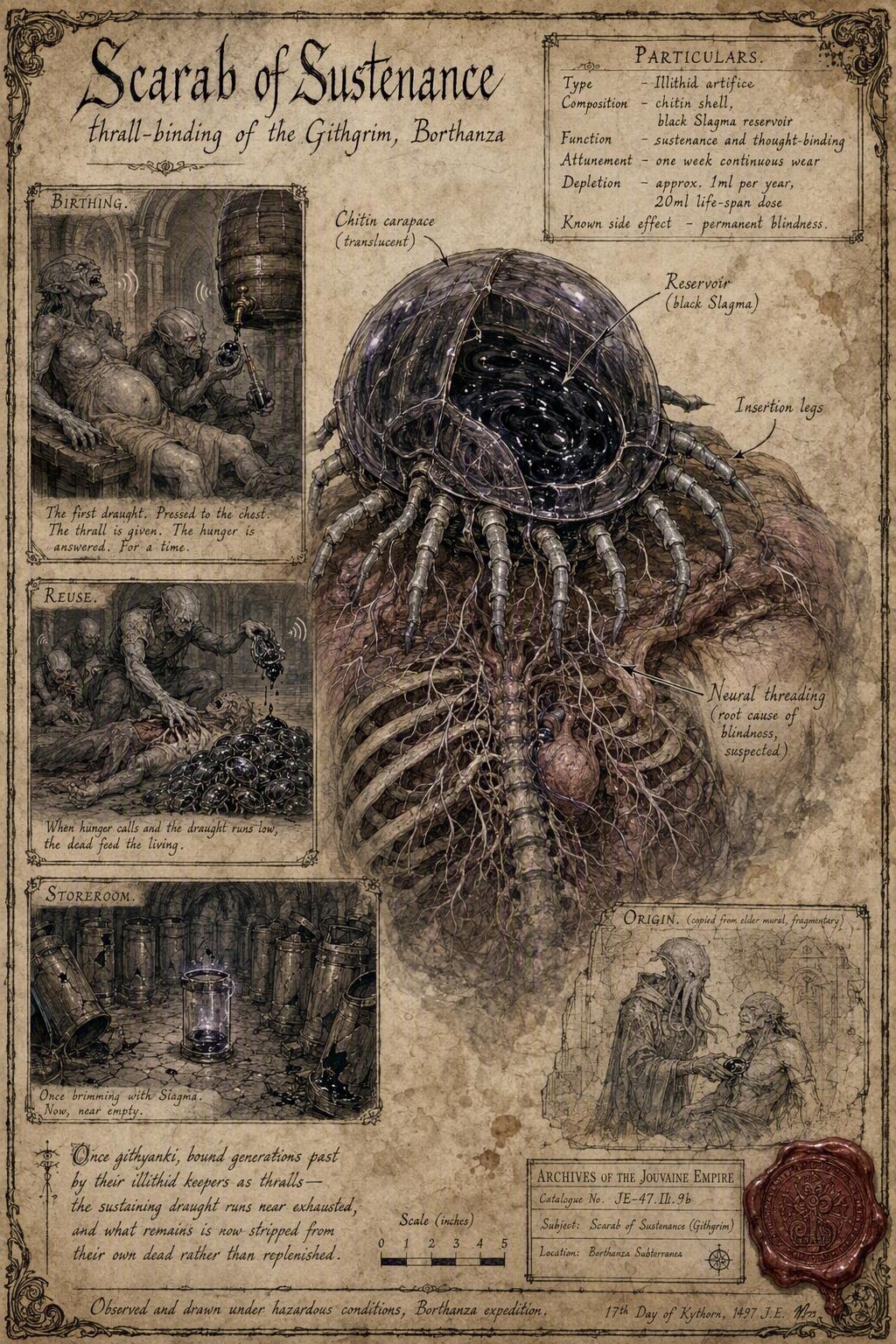
What keeps them alive – and blind – is a Scarab of Sustenance.
A translucent, beetle-shaped implant, fitted with pale grey legs that burrow into the ribcage and inject a measure of black Slagma, a harsher, rawer cousin of the same substance that charges a Coraman crystal.
The dose is metered to last a lifetime, roughly a millilitre draining away each year against a twenty-millilitre fill, continually nourishing its host at the cost of two hours’ sleep doing the work of eight – and, as an apparently unavoidable side effect, permanent blindness.
The Agents watched the attachment happen once, in the temple’s old chapel-and-dining hall: a mother in nearly silent labour, a second Grimlock priming a fresh scarab at a barrel of the fluid, then pressing it into the newborn’s chest to a wet tearing sound and one muffled scream.
The supply has all but run out.
Of the dozens of cylinders stored in the temple, only one still holds any fluid at all – a bare sixty millilitres left to sustain what remains of the colony.
What the Grimlocks do about that shortage is as practical as it is grim: when one of their own dies, the others drag the body to the scarab area, tear the implant back out of the ribcage, toss it onto a waiting pile for reuse, and start feeding on what’s left.
Nothing about the ritual reads as cruelty to them. It reads as the only thing keeping the rest alive one more year.
STATUS: Filed under The Unknown as a species record, not an individual. Whatever debt the illithids’ original thralls once owed their captors, the captors have been in stasis for centuries and the debt is still being paid – in flesh, and in scarabs stripped from the dead, by a population that has no memory left of why.